
Bleeding gums aren't normal: what they mean for your mouth and your body
Why bleeding gums are a warning sign, the 30-second floss test, how gum disease is linked to heart disease, diabetes, pregnancy and dementia, and how it is treated in Pflugerville.
Published October 14, 2026 · Medically reviewed by Dr. Richa Wahi, DMD, MPH, BDS
Bleeding gums aren't normal. Healthy gums don't bleed when you brush or floss. Bleeding is the earliest sign of gum disease, which affects nearly half of American adults over 30 and is linked to heart disease, diabetes, pregnancy problems and dementia. The good news: caught early, it is reversible with a cleaning and two weeks of daily flossing.
Key takeaways
- Pink in the sink means inflamed gums, not "brushing too hard".
- Gum disease is silent: 42% of adults over 30 have periodontitis, and most don't know.
- It is linked to heart attack, stroke, diabetes control, preterm birth and dementia. These are associations, not proven causes, but they are reason enough to act.
- Early gum disease is reversible; advanced gum disease can be stopped with a deep cleaning.
Why do my gums bleed when I brush or floss?
Gums bleed because plaque, the sticky film of bacteria along the gum line, has inflamed them. The body sends extra blood to fight the bacteria, the tissue swells, and the lightest touch makes it bleed. This stage is called gingivitis. It is not caused by flossing; flossing just reveals it.
Other causes are less common but worth knowing: pregnancy hormones, some blood-thinning medicines, vitamin C or K deficiency, and a brush with hard bristles. If your gums bleed and you are not sure why, a checkup settles it in ten minutes.
The 30-second floss test
Floss gently between every tooth tonight and look at the floss and your gums. Any pink or red means inflammation at that spot. Do it every night for two weeks. If the bleeding stops, you have reversed early gum disease. If it continues, or if any area is swollen or tender, book a cleaning; the plaque there has hardened into tartar, which only a professional cleaning removes.
What is gum disease?
Gum disease (periodontal disease) is an infection of the gums and, later, the bone that holds your teeth. It has two stages:
- Gingivitis: red, swollen gums that bleed easily. Reversible. The National Institute of Dental and Craniofacial Research notes that early gum disease "can often be reversed by daily brushing and flossing".
- Periodontitis: the gums pull away from the teeth and form pockets, the infection reaches the bone, and teeth loosen. Not reversible, but it can be stopped.
The CDC reports that 42% of adults aged 30 and older have periodontitis, and about 8% have severe periodontitis. Smoking is the biggest risk factor, followed by diabetes, age and family history.
What are the warning signs of gum disease?
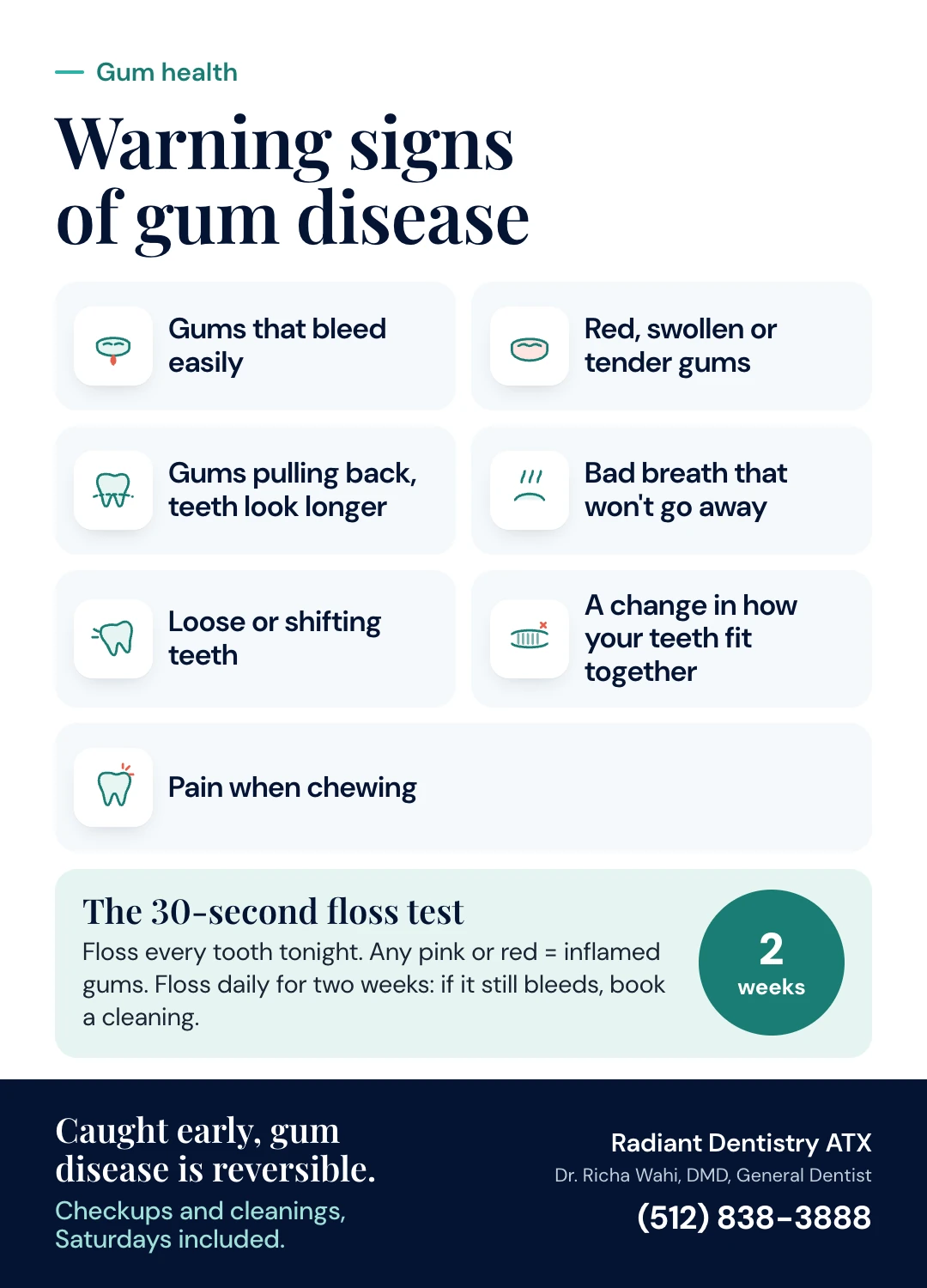
According to the American Dental Association, see a dentist if you notice any of these:
- Gums that bleed easily
- Red, swollen or tender gums
- Gums that have pulled away from the teeth, making teeth look longer
- Persistent bad breath or a bad taste
- Loose or shifting teeth, or a change in how your teeth fit together
- Pain when chewing
Gum disease can also progress with no symptoms at all, which is why checkups include a gum measurement.
How does gum disease affect the rest of your body?
Gum disease is a long-term source of bacteria and inflammation that the rest of the body has to deal with. Research links it to several serious conditions. In each case the link is an association, not a proven cause, but the pattern is consistent enough that heart, diabetes and pregnancy organisations all recommend treating gum disease.
Gum disease and heart disease or stroke
The American Heart Association's December 2025 scientific statement says that "numerous studies have found that periodontal disease is associated with an increased risk of heart attack, stroke", while noting that "a cause-and-effect relationship has not been confirmed". The statement adds that treating and controlling gum disease "may contribute to the prevention" of cardiovascular disease.
Gum disease and diabetes
The relationship runs both ways. People with diabetes have a higher chance of gum disease, and the NIDCR notes that "having gum disease may make your blood sugar harder to control". If you have diabetes, gum care is part of managing it, and we coordinate with your doctor when needed.
Gum disease and pregnancy
About 60% to 75% of pregnant women develop gingivitis, and the CDC notes that periodontitis "has been associated with poor pregnancy outcomes, including preterm birth and low birth weight". The CDC is clear that "dental care is safe and important during pregnancy", so a cleaning during pregnancy is a good idea, not a risk.
Gum disease and dementia
In 2020 the National Institute on Aging reported a large study linking gum disease bacteria with later dementia, including Alzheimer's disease. The science here is newer and less settled than for heart disease or diabetes, and it does not prove that gum disease causes dementia. It is one more reason to keep gums healthy as you age.
Can a tooth abscess be dangerous?
Yes. An abscess is a pocket of infection at the root of a tooth or in the gum. Left untreated it can spread to the face, jaw and neck, and in rare cases become a medical emergency. Swelling in the face, trouble swallowing or a fever with a toothache needs same-day care. Our toothache guide explains when to call us and when to go to the ER.
How is gum disease treated?
Treatment depends on the stage. Gingivitis is treated with a professional cleaning and better home care. Periodontitis is treated with a deep cleaning (scaling and root planing) that removes tartar and bacteria from below the gum line, followed by maintenance cleanings every three to four months.
At Radiant Dentistry ATX in Pflugerville, a gum visit works like this:
- Exam and gum measurement. We measure the pocket depth around each tooth; 1-3 mm is healthy, deeper pockets mean periodontitis. Digital X-rays show whether bone has been lost.
- Cleaning or deep cleaning. Gingivitis needs a regular cleaning. Periodontitis needs scaling and root planing, done with the gums numbed, usually over one or two visits.
- Re-check in four to six weeks to confirm the gums have tightened and the bleeding has stopped.
- Maintenance every three to four months, because the bacteria that cause periodontitis return within about 90 days.
Dr. Richa Wahi, DMD, MPH, has 15 years of experience and sees patients from Pflugerville, Wells Branch, Round Rock, North Austin, Hutto and Manor. Most PPO plans cover regular cleanings in full and part of a deep cleaning; see our deep cleaning page for current fees and coverage.
How do I stop my gums from bleeding?
Most bleeding gums stop within two weeks of this routine:
- Brush twice a day for two minutes with a soft brush and fluoride toothpaste, angling the bristles toward the gum line.
- Clean between your teeth once a day with floss or interdental brushes. Keep going even if it bleeds at first; stopping is what lets the plaque win.
- Have a professional cleaning every six months, or every three to four months if you have had gum disease.
- Don't smoke. Smoking is the biggest risk factor for gum disease and makes treatment less successful.
- Manage diabetes, and tell us if you are pregnant or taking blood thinners.
If the bleeding hasn't stopped after two weeks, or your gums are swollen, receding or sore, book a checkup and cleaning. Call (512) 838-3888; new patients are welcome and we are open Saturdays.
Treatments mentioned in this guide
Cleanings & Checkups
The visit that keeps everything else simple: a thorough cleaning, a careful exam and an honest plan.
Learn moreDeep Cleaning & Gum Treatment
Bleeding gums, bad breath or tartar under the gumline? A deep cleaning removes the infection a regular cleaning cannot reach.
Learn more
Emergency Dentist
Same-day care for toothache, broken teeth, swelling and lost fillings — call and we'll get you comfortable fast.
Call nowQuestions patients ask us
No. Healthy gums don't bleed when you brush or floss. Bleeding usually means plaque along the gum line has inflamed the gums (gingivitis). If you have just started flossing, the bleeding should stop within about two weeks of daily flossing; if it doesn't, book a checkup.
Early gum disease (gingivitis) is reversible with a professional cleaning and daily brushing and flossing. Periodontitis, where the bone has started to go, can't be reversed, but it can be stopped and controlled with a deep cleaning and regular maintenance visits.
Gum disease is associated with a higher risk of heart attack and stroke, according to the American Heart Association's 2025 scientific statement. A cause-and-effect link hasn't been proven, and the two conditions share risk factors such as smoking. Treating gum disease is still worth it: it reduces inflammation in the body and protects your teeth.
No. The gums are numbed first, so you feel pressure rather than pain. Gums can be tender for a day or two afterwards, and over-the-counter pain relief is usually enough.
Yes. Dental care, including cleanings and gum treatment, is safe and recommended during pregnancy, and 60-75% of pregnant women get gingivitis. Tell us you're pregnant when you book and we plan the visit around it.
A regular cleaning treats gingivitis and is covered by most PPO plans at 100%. A deep cleaning (scaling and root planing) is billed per quadrant, and most PPO plans cover part of it. We check your benefits and quote the cost before we start. Details are on our deep cleaning page.
Ready to schedule your visit?
Book online in about two minutes, or call and speak with our team. We are happy to answer any questions before your appointment.