
Do I need a root canal? The signs, what it really feels like, and what it costs in Pflugerville
The tooth-pain signs that point to a root canal, the 30-second hot-and-cold test, what the visit feels like, and what it costs with and without insurance.
Published October 27, 2026 · Updated October 31, 2026 · Medically reviewed by Dr. Richa Wahi, DMD, MPH, BDS
A root canal is the treatment that saves a tooth whose nerve has become infected, and it is nothing like its reputation. The tooth is numbed, the infected tissue is removed, and the pain you walked in with goes away. This guide covers the signs that you need one, what the visit really feels like, what it costs in Pflugerville, and why keeping the tooth beats pulling it.
What is a root canal, in plain English?
Inside every tooth is a soft core called the pulp, which holds the nerve and blood vessels. A root canal removes that tissue when it is inflamed or infected, then cleans, disinfects and seals the hollow canals inside the roots. The tooth stays in your mouth, keeps its root in the bone, and works normally once it is restored with a filling or crown.
The American Association of Endodontists (the specialists in this field) puts it simply: a root canal "is a dental procedure to remove inflamed or infected pulp on the inside of the tooth", it "can usually be completed in one or two appointments", and "with proper care, most teeth that have had root canal treatment can last a lifetime".
Bacteria reach the pulp in three main ways: a deep cavity, a crack or chip, or repeated work on the same tooth. Once inside, the infection cannot heal on its own, because the tooth has no way to fight it.
What are the signs that I need a root canal?
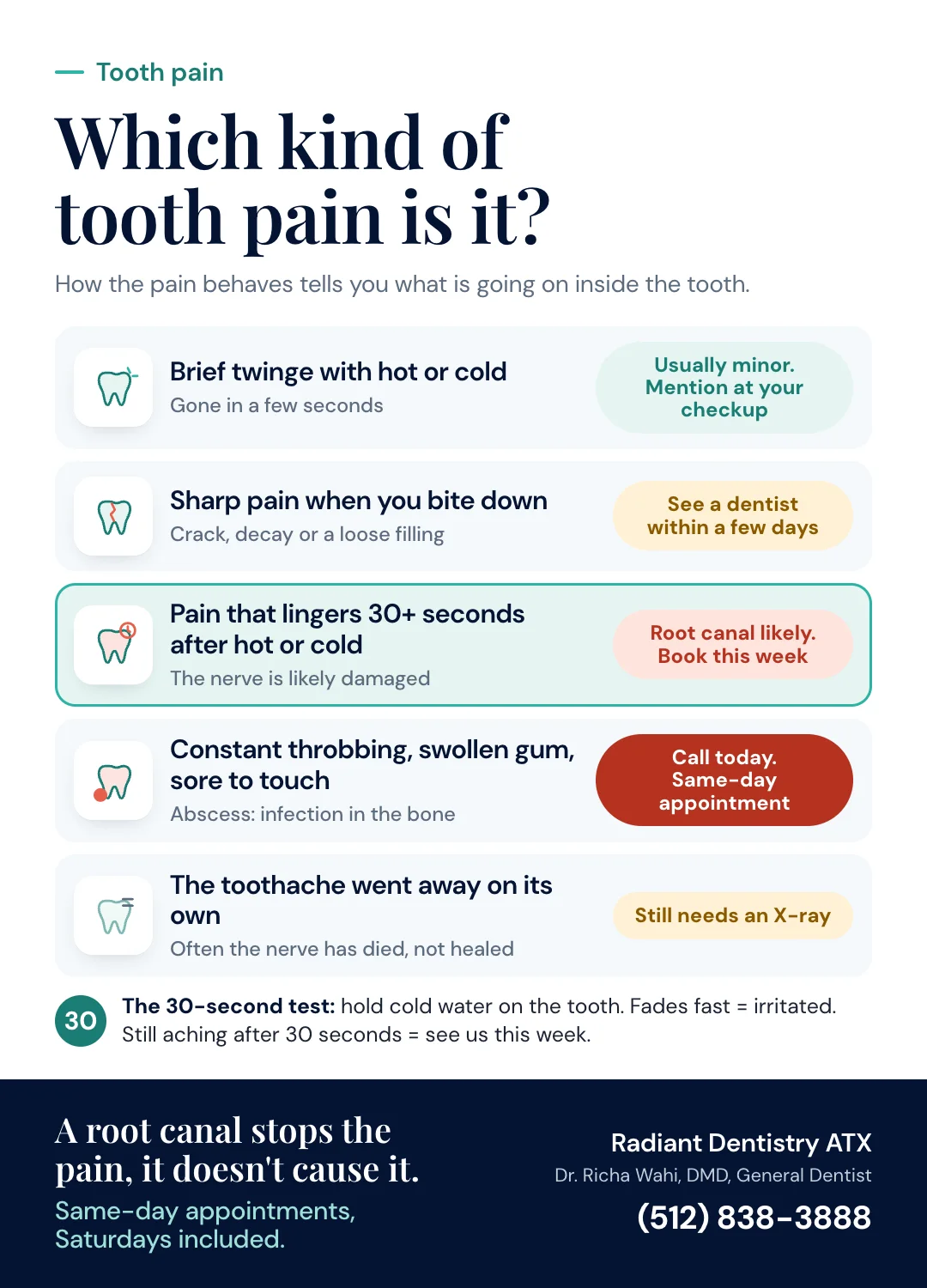
The classic sign is a toothache that lingers or throbs rather than a quick twinge. According to the American Association of Endodontists, different kinds of tooth pain point to different problems:
- Momentary sensitivity to hot or cold that fades in seconds is usually minor: a small cavity, a loose filling or receding gums. Worth mentioning at your next checkup.
- Sharp pain when biting down can mean decay, a cracked tooth, or damage reaching the pulp. See a dentist within a few days.
- Pain that lingers for more than 30 seconds after hot or cold food suggests the pulp has been permanently harmed. This is the sign that most often ends in a root canal. Book as soon as possible.
- Constant, severe pain with pressure, a swollen gum or sensitivity to touch points to an abscess, an infection in the bone around the root. Call the same day.
Other signs to take seriously: a pimple-like bump on the gum, a bad taste that keeps coming back, a tooth that has darkened compared with its neighbours, or swelling of the gum, cheek or jaw. And sometimes there are no symptoms at all; the infection shows up on a routine X-ray, which is one of the reasons checkups include them.
The 30-second hot-and-cold test
Take a sip of cold water and hold it against the sore tooth, then count. If the pain fades within a few seconds, the nerve is irritated but probably alive. If it keeps aching for 30 seconds or more, or the pain builds after you swallow, the nerve is likely dying and the tooth needs to be looked at this week. The same applies to hot drinks; a tooth that throbs after coffee and settles with cold water is a classic sign of an infected nerve.
My toothache went away. Am I in the clear?
Probably not. When an infected nerve finally dies, the pain often stops for a while, because the nerve can no longer send signals. The infection is still there and is now spreading into the bone at the tip of the root. Weeks or months later it returns as swelling or an abscess, and a tooth that was easy to save becomes harder. A toothache that disappeared on its own still needs an X-ray.
Does a root canal hurt?
No. The tooth is completely numbed before anything starts, so the visit feels like having a filling. What people remember as "root canal pain" is the toothache from the infection before treatment, which is exactly what the root canal removes.
The American Association of Endodontists addresses this directly: "Modern root canal treatment is designed to eliminate pain, not cause it", and "the pain people associate with root canals is actually caused by the infection inside the tooth". In their words, "most patients say the experience feels similar to getting a routine filling", and "after your procedure, you can usually return to your normal routine the same day".
At Radiant Dentistry ATX we do not begin until you are fully numb, and we test before we start. If you are nervous about dental visits, nitrous oxide (laughing gas) is available, and you can raise a hand at any point to pause.
What happens during a root canal?
A root canal at our Pflugerville office takes 60 to 90 minutes and is usually finished in one visit. Here is the sequence:
- Diagnosis. An exam and digital X-ray confirm the nerve is involved and show the number and shape of the roots. Front teeth have one canal; molars usually have three or four.
- Numbing. Local anesthetic around the tooth. For a hot, infected molar we sometimes use an extra technique to make sure the numbness is complete.
- Isolation. A small rubber sheet keeps the tooth dry and keeps bacteria from saliva out of the canals.
- Cleaning and shaping. Through a small opening in the top of the tooth, the infected pulp is removed and each canal is cleaned, disinfected and shaped with fine instruments.
- Sealing. The canals are filled with a rubber-like material called gutta-percha and the opening is closed with a filling.
- Restoration. Back teeth get a crown within a few weeks, because a root-canalled molar is more brittle and a crown stops it cracking. Front teeth often need only a filling.
A tooth with an active abscess may be cleaned and medicated at the first visit and sealed at a second one, a week or two later, once the infection has settled.
How much does a root canal cost in Pflugerville?
A root canal costs more for a molar than for a front tooth, because molars have more canals and take longer. Delta Dental puts the national out-of-network fees, from its 2025 data, at approximately $1,200 for a front tooth, $1,300 for a premolar and $1,500 for a molar. The final filling or crown is a separate fee.
With dental insurance, Delta Dental notes that "it is common for dental insurance plans to cover 50% - 80% of the cost of a root canal after the deductible has been met". The crown is usually a separate major-restorative benefit, and both count against your plan's annual maximum. If you still have unused benefits this year, a root canal that is already needed is a sensible way to use them before they reset on December 31.
At Radiant Dentistry ATX we check your benefits before the visit and give you a written quote for the root canal and the crown before any treatment starts, so there are no surprises. Patients without insurance can start with the $99 emergency exam (a focused exam and X-rays, a $158 value), which tells you exactly what the tooth needs and what it will cost. Financing is available for the treatment itself.
Root canal or pull the tooth?
Save the tooth whenever it can be restored. An extraction is cheaper on the day, but the gap it leaves changes your bite, lets neighbouring teeth drift, and usually needs an implant or bridge later, which costs more than a root canal and crown combined. The American Association of Endodontists' advice is that "whenever possible, saving your natural tooth with root canal treatment is the preferred option", and that extraction "often leads to additional procedures".
Root canals also last. A study of 1,462,936 root-canal-treated teeth across all 50 states, published in the Journal of Endodontics, found that "97% of teeth were retained in the oral cavity 8 yr after initial nonsurgical endodontic treatment". Of the few teeth that were eventually lost, 85% had never been crowned. The lesson is simple: have the root canal, then get the crown.
You may have read online that root canals cause illness or cancer. That idea comes from research done nearly a century ago that has since been discredited; the endodontists' association states that "there is absolutely no scientific evidence linking root canal treatment to cancer", and that "untreated dental infections pose a far greater risk to your health than a properly treated tooth".
We recommend extraction only when a tooth is cracked below the gum line, has lost too much structure to hold a crown, or has bone loss that a root canal cannot fix. If that is the case, our implants, bridges and dentures guide explains the options.
How long can a root canal wait?
Not long. Once the nerve is infected the tooth cannot heal itself, and every week of waiting lets the infection spread further into the bone. The American Dental Association warns that without treatment "bacteria can damage the bone that keeps your tooth connected to your jaw" and that "an infection can also put you at risk of losing your tooth completely".
If you have been told you need a root canal, book within days. Call the same day, or go to the emergency room if we are closed, when you have:
- Swelling of the face, jaw or neck
- A fever with the toothache
- Trouble swallowing or opening your mouth
Our toothache guide explains what to do tonight while you wait for your appointment, and which symptoms mean the ER rather than the dentist.
What happens after a root canal?
Expect the tooth to feel tender for two to four days, especially when biting; over-the-counter pain relief is usually enough. Avoid chewing on that side until the permanent filling or crown is in place, since a temporary filling can crack. Brush and floss the tooth normally.
Call us if pain gets worse instead of better after day three, if swelling appears, or if the temporary filling falls out. Then keep the crown appointment: it is the step that turns a 97% success rate into a tooth that lasts a lifetime.
Dr. Richa Wahi, DMD, MPH, has 15 years of experience and performs root canals in-house at Radiant Dentistry ATX, so you do not need a referral or a second office. We see patients from Pflugerville, Wells Branch, Round Rock, North Austin, Hutto and Manor, keep same-day appointments for tooth pain, and are open Saturdays. If a tooth is aching, call (512) 838-3888 or read about root canal treatment at our office.
Treatments mentioned in this guide
Emergency Dentist
Same-day care for toothache, broken teeth, swelling and lost fillings — call and we'll get you comfortable fast.
Call now
Dental Crowns & Bridges
Protect a damaged tooth or replace a missing one with a crown or bridge that looks and feels like your own.
Learn more
Root Canal Treatment
Stop the pain and keep your natural tooth — modern root canals are far gentler than their reputation.
Learn moreQuestions patients ask us
No. The tooth is fully numbed before anything starts, so the visit feels like having a filling. The American Association of Endodontists says the pain people associate with root canals is caused by the infection inside the tooth, which is exactly what the treatment removes. Mild tenderness for a few days afterwards is normal.
Usually 60 to 90 minutes, and most teeth are finished in a single visit. A tooth with an active infection or unusually curved roots may need a second visit. The crown that protects a back tooth afterwards is a separate, shorter appointment a few weeks later.
Yes. You can drive yourself and return to your normal routine the same day. Your lip and cheek will be numb for two to three hours, so wait to eat until the feeling returns, then chew on the other side until the permanent filling or crown is in place.
National averages are about $1,200 for a front tooth, $1,300 for a premolar and $1,500 for a molar, based on Delta Dental's 2025 data; a crown is extra. At Radiant Dentistry ATX we quote the exact fee in writing before starting, and the $99 emergency exam with X-rays is available for patients without insurance.
Only on the day. An extraction costs less than a root canal, but the gap it leaves usually needs an implant or bridge, which costs far more than the root canal and crown together. Saving the tooth also keeps the bone and your bite intact, which is why dentists recommend it whenever the tooth can be restored.
Usually not. Antibiotics cannot cure an infected nerve because there is no blood supply left inside the tooth to carry them there; the root canal itself removes the infection. We prescribe antibiotics only when the infection has spread to the face or jaw, or when a medical condition calls for them.
Usually for life. A study of 1.46 million root-canal-treated teeth across the USA found 97% were still in place eight years later. Most of the few that were lost had never been crowned, so getting the crown placed on a back tooth is the single best way to protect your investment.
Ready to schedule your visit?
Book online in about two minutes, or call and speak with our team. We are happy to answer any questions before your appointment.